PDF
PDFThe Flowertown Festival, Summerville
The Southeast Tourism Society has named the Flowertown Festival in Summerville, SC as one of  the Top 20 Events in the Southeast. The annual Summerville Family YMCA Flowertown Festival, a 3 day event celebrated every spring since 1972, celebrates the ushering in of warm weather and the passing of the cold.
Held in Azalea Park (map/directions) The festival is the largest in South Carolina and features food vendors, a tour of local historic homes and gardens, arts & crafts, live entertainment, a tennis classic and even a children's carnival complete with events plus art & crafts for the young ones.
The 2015 Flowertown Festival will run from March 27 to March 29, 2015.
Admission to the festival is FREE, it is a family event, no alchohol is served and no pets are allowed.
For more information call the Summerville Family YMCA at (843) 871-YMCA (9622).
Boeing Family Settles in The Ponds
Doug Channer developed both his love for flying and his interest in Charleston, South Carolina, during his lengthy career in the U.S. Air Force.
"I became familiar with Charleston way back in the early 1980s when guys in the service talked about wanting to retire here," said Channer. "I was in Charleston all the time for staging or presidential support, but I didn’t get to explore much. 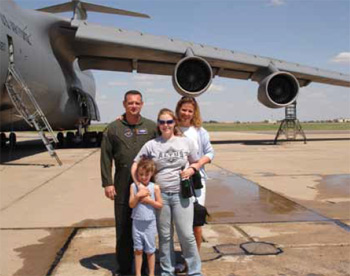 Now I understand why so many of the guys wanted to stay. It’s neat to see how much the city has changed since I first came here."
For the first decade of his Air Force career, Channer flew B-52 bombers, then spent the next 20 years on the C-5A Galaxy, a large military transport plane. He is now enjoying his retirement from the military working work with the Lowcountry’s newest and largest industrial employer, The Boeing Company. As a skills advisor, he helps train new employees, as well as those already on the job.
"I have handled and flown Boeing products for 30 years while in the Air Force, so it’s great to continue working with such an outstanding product," Channer explained.
Originally from Cincinnati, Channer’s most recent assignment was in Huntsville, Alabama, which is similar in some ways to Charleston but vastly different in others.
The Times of Our Lives: Celebrating the Azalea
 Although Summerville’s earliest settlers date as far back as the late 1600s, the town’s golden era must surely be the first part of the 20th century. It had long been a refuge for coastal residents who fled the punishing heat and relentless mosquitoes
for which the Lowcountry is known but it was about to become world famous. In 1899, the International Congress of Physicians proclaimed Summerville one of the two best places in the world for people suffering from lung disorders. The turpentine scent emitted by the pine trees was considered
to be the cure for a variety of respiratory ailments. A long time resident remembers it well.
Although Summerville’s earliest settlers date as far back as the late 1600s, the town’s golden era must surely be the first part of the 20th century. It had long been a refuge for coastal residents who fled the punishing heat and relentless mosquitoes
for which the Lowcountry is known but it was about to become world famous. In 1899, the International Congress of Physicians proclaimed Summerville one of the two best places in the world for people suffering from lung disorders. The turpentine scent emitted by the pine trees was considered
to be the cure for a variety of respiratory ailments. A long time resident remembers it well.
"It was so popular," Helen Tovey says. "It was world famous because of the pine air. People even came from Europe. It was prescribed by doctors."
Suddenly the town of Summerville became a destination not only for those seeking to breathe in the healing atmosphere but for travelers wishing to experience the famed southern beauty of the "flower town in the pines." The town boomed as hotels and inns were built to accommodate the many visitors. And, as so often happens, more than a few decided to stay.
Summerville, South Carolina - The Original Summer Resort Town
Cool breezes whispering through forests of pine were what brought Summerville its first visitors. Lowcountry 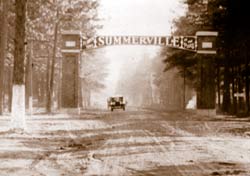 residents found in the town’s lofty location a respite from the
subtropical heat and disease of the summer. They believed that harmful
gases rose up from the low-lying rice fields and swamps along the
coast and caused malaria. What they didn’t know then was that
the mosquitoes were causing the malaria. What they did know, though,
was that they felt better in this village among the pines.
residents found in the town’s lofty location a respite from the
subtropical heat and disease of the summer. They believed that harmful
gases rose up from the low-lying rice fields and swamps along the
coast and caused malaria. What they didn’t know then was that
the mosquitoes were causing the malaria. What they did know, though,
was that they felt better in this village among the pines.
Those healthy breezes were enjoyed in what were known as "mosquito houses," non-insulated structures designed to allow air to flow freely throughout. They consisted of two rooms on each side of a wide hall, and a fireplace in each room. By 1828, twenty-eight families had built summer cottages, and Summerville was born.
It didn’t take long for this quaint village retreat to become popular. By 1830 the South Carolina Railroad came through Summerville and a new town plan was laid out with streets parallel and perpendicular to the tracks for easy travel access. The "new town," as it was called, was just east of the original settlement of Old Summerville and Mayor Edward L. Hutchinson became its first mayor.
Large tracts of pineland that had been purchased by the railroad to fuel its locomotives were later divided into parcels for residential use, and sold with a covenant to protectnot less than 15 pine trees per parcel. Specifications on size and circumference were included with the purchase. It would be forever and a day before the residents would lose the precious trees that provided their healthful air.
I Love Summerville | Summerville Builder Info | Taste of Summerville
RECENT POSTS
» Boeing Family in The Ponds
» Celebrating the Azalea
» Original Summer Resort Town
CATEGORIES
Find a Summerville DentistRelocation Guide Summerville SC